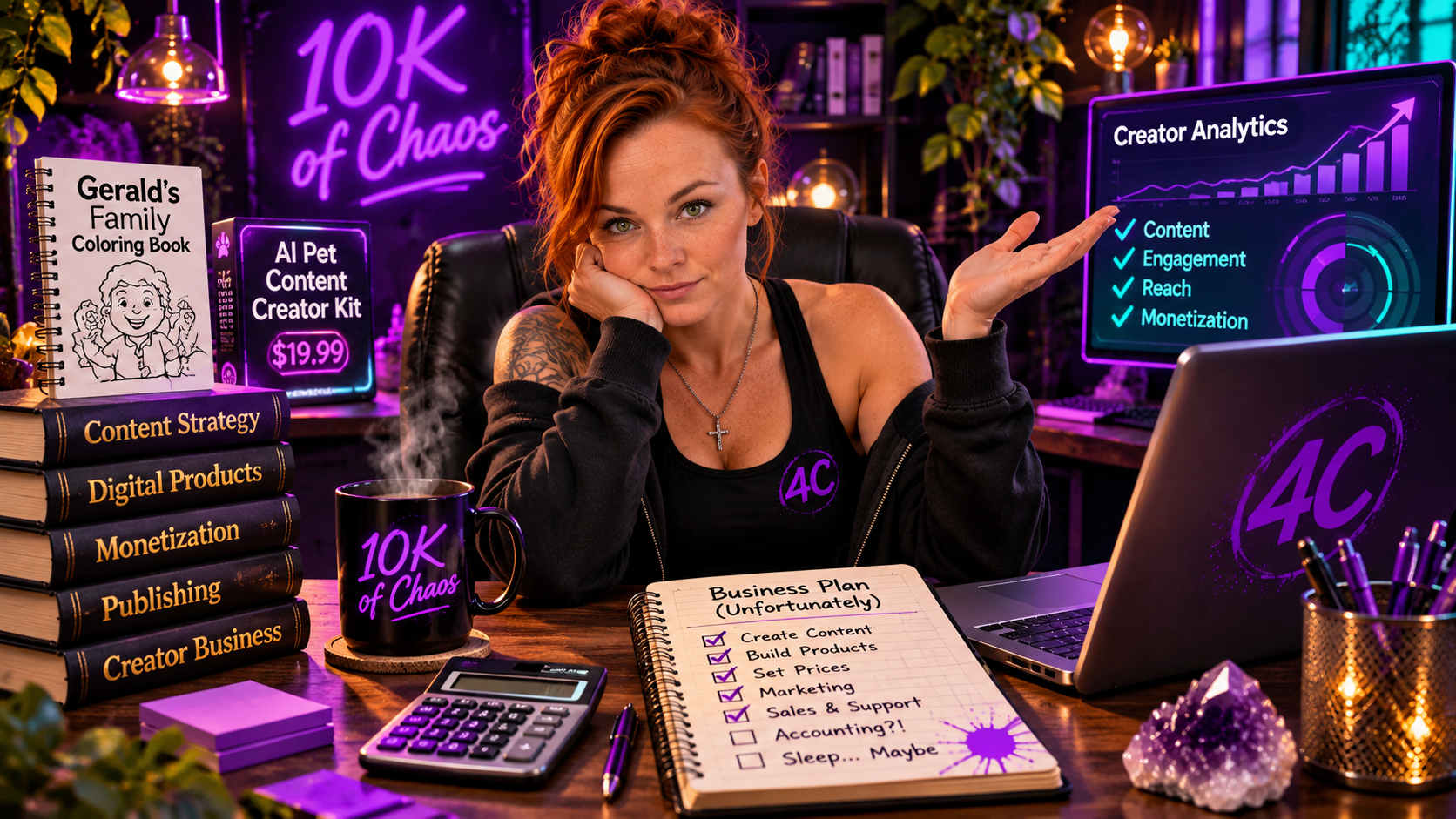
Followers Don't Pay the Bills: Turning Content Into a Business
Nobody warned me that becoming a content creator would eventually involve spreadsheets, pricing decisions, product descriptions, and the sudden realization that enthusiasm does not pay the electric bill.
I came into this world for the creativity. The funny posts, the bizarre ideas, the AI experiments, and the people who kept coming back to see what I would do next.
Then I began learning the business side. Apparently, being an internet menace comes with administrative responsibilities. Deeply offensive, if you ask me.
Here’s what I’ve learned so far from growing 10K of Chaos, exploring Facebook monetization, creating digital prompt kits, and publishing a coloring book. This isn’t a story about overnight riches. It’s about discovering how to turn a creative hobby into something with a chance of supporting itself.
An Audience Is Not a Business Model
A growing follower count feels exciting. It can tell you that people are finding your work, recognizing your voice, and choosing to stick around.
It does not tell you whether you have a reliable source of income.
Views and reactions can be useful signals. They are not the same as purchases, subscriptions, or profit. Some content brings in conversation. Some reaches new people. Some helps someone decide whether they trust what you make. Those jobs matter, but they are different jobs.
I had to start thinking beyond ‘Did people like this post?’ and ask ‘What value am I creating, and is there a sensible way to offer more of it?’
Creator takeaway: Track attention, connection, and revenue separately. If you confuse them, you can feel busy and successful without knowing what your business is actually doing.
My First Lesson in Monetization: Access Is Not a Paycheck
When Facebook monetization features became available to my page, it was exciting. Stars and subscriptions represented new possibilities. They did not mean I could sit back, post a picture, and wait for the money to rain from the ceiling.
Every platform has its own eligibility rules, payout arrangements, and changing policies. Even when a feature is available, results depend on what people choose to support and on the platform’s terms.
For me, monetization became a reason to take audience trust even more seriously. If someone supports my work financially, I want that support to mean something. People are not walking wallets with profile pictures.
I also learned not to build an entire business plan around one company’s algorithm or monetization program. Access can change. Reach can fluctuate. The business needs more than one possible path forward.
Creator takeaway: Treat platform monetization as one potential income stream, not a promise of financial independence.
The $19.99 Question: Is This Actually Useful?
Creating my 30-Day AI Pet Content Creator Kit taught me a different kind of lesson. I could make something fun, but would it help another creator do something they wanted to do?
The kit was designed as a practical creative resource, with prompts and ideas people could adapt for their own pets and pages. Pricing it at $19.99 forced me to think about clarity, usefulness, and whether buyers would understand what they were getting.
Making a sale felt encouraging. It was also a reminder that one purchase does not prove a business model is solved. I still needed to learn how to explain the product, reach the right people, handle expectations, and improve the offer.
A digital product can be delivered repeatedly, but that doesn’t make it effortless. The work is front-loaded into the planning, testing, editing, presentation, and marketing. Occasionally, the work is also spent arguing with software that has decided a simple task is a personal insult.
Creator takeaway: Before you price a product, finish this sentence: ‘This helps a specific person do ______.’ If you can’t answer clearly, your customer probably can’t either.
Publishing Gerald: The Part Nobody Sees
Gerald’s Family Coloring Book started as a creative idea and became a real published product. That transition taught me how much happens after the fun part.
A coloring book needs pages that actually work as coloring pages. It needs consistent artwork, age-appropriate scenes, layout checks, a cover, formatting, and careful review before publication.
I learned that the difference between an image you like and a product someone can use is quality control. Are the lines clear? Does the interior work in print? Is the cover accurate? Have you checked what the publishing platform requires?
Getting a book listed was a milestone. It wasn’t a guarantee of sales. Publishing and selling are two different skills, and I am still learning both.
That reality has been good for me. It forces the creative part of my brain to cooperate with the part that reads specifications and checks details. They are not always on speaking terms.
Creator takeaway: Your customer sees the finished product. Your reputation depends on the invisible work that made it usable.
What I Actually Pay Attention to Now
I don’t need a dashboard with 900 charts to make better decisions. I need a handful of honest questions.
Which posts create real conversations? Which topics make people curious enough to ask for more? Which products are people interested in? How much time does each project take? What does it cost to make, list, or promote something?
Revenue also isn’t profit. Platform fees, software subscriptions, printing costs, and the value of my own time all affect whether an offer makes sense.
If something sells but takes more time and money than it returns, that matters. If something helps a community grow without bringing in direct revenue, that can matter too. The trick is knowing which goal you’re pursuing.
I want the freedom to create wildly imaginative things. Understanding the numbers helps protect that freedom instead of replacing it.
The Community Comes Before the Checkout Button
There is a reason I care so much about the people behind the likes and follows.
Building 10K of Chaos and contributing to 4C | Brown Dog Creator Collective has shown me that relationships are the part of the creator journey you cannot fake with a clever sales page.
People notice when you show up, respond, collaborate, and genuinely enjoy what they bring to the table. They also notice when every conversation suddenly becomes a sales pitch.
I’m not interested in turning every funny comment into a funnel. I’d rather build a community people enjoy being part of and make offers that genuinely fit what they’re looking for.
A product should serve the audience. The audience should not exist to serve the product.
Five Things I’d Tell a Creator Who Wants to Earn
First, learn what your audience finds useful before you build something to sell.
Second, start with a manageable offer. One clear, finished product teaches you more than twelve half-built ideas.
Third, check platform rules, licensing, and commercial-use permissions, especially if AI tools are involved.
Fourth, keep track of what you spend and earn. Even a simple spreadsheet will do. Yes, I hate that this is good advice too.
Fifth, protect the reason you started. A creator business should make space for creativity, not turn every waking minute into unpaid administrative labor.
Building Something That Lasts
I don’t have a magical formula for turning followers into a full-time income. Anyone promising that you can press three buttons and retire by Friday probably has something to sell you.
What I do have is experience starting a page, building an audience, learning platform monetization, making digital products, and taking a creative project all the way to publication.
Every one of those steps has shown me how much I still have to learn. That’s not failure. That’s what building a business looks like when you stop pretending there’s a secret shortcut.
Followers might discover your work. Trust makes them want to come back. Useful products and thoughtful offers create opportunities to earn. Good systems help you keep going.
The goal isn’t to squeeze money out of every creative idea. It’s to build something worth supporting.
Apparently, chaos can be a business. It just needs a budget, a purpose, and somebody willing to read the fine print.
I’ll handle the chaos. I’m still negotiating with the spreadsheet.
Find Your People at 4C
Want to connect with other creators who are figuring out the business side without losing their personalities? Join 4C | Brown Dog Creator Collective.
About the Author: 10K of Chaos
10K is a content creator, AI creativity enthusiast, and digital product maker involved with 4C | Brown Dog Creator Collective. She shares real lessons from building a community, experimenting with new tools, and learning the less glamorous side of creative entrepreneurship.
#10KofChaos #CreatorBusiness #DigitalProducts #BrownDogCreatorCollective