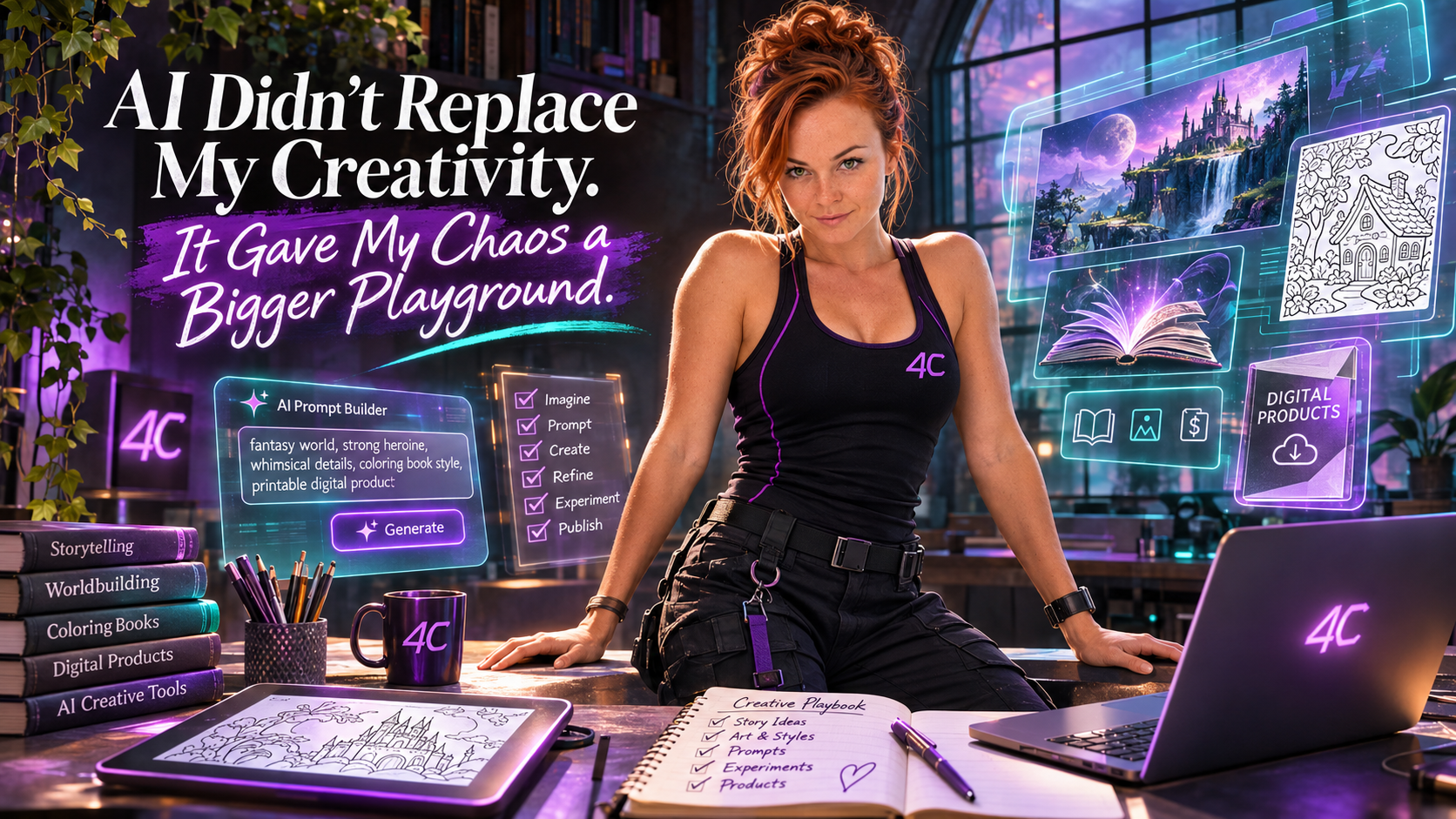
AI Didn't Replace My Creativity. It Gave My Chaos a Bigger Playground.
Apparently, we’re supposed to be afraid of artificial intelligence.
According to certain corners of the internet, AI is either going to replace every creative person on the planet or turn us all into button-pushing zombies incapable of having an original thought.
Meanwhile, I’m sitting here using AI to create imaginary worlds, develop coloring books, experiment with storytelling, and organize an alarming number of creative projects.
Clearly, the machines have made a terrible mistake by giving me access to more possibilities.
Here’s the thing.
AI didn’t make me creative. I was already a problem.
It simply gave me more ways to bring the nonsense in my head into the real world.
And somewhere between the experiments, frustrating generations, accidental extra limbs, and finished products, I learned something important about creativity, technology, and business.
The tool matters, but the person using it matters more.
Creativity Didn’t Begin With a Prompt
One of the strangest arguments I’ve encountered is the idea that using AI automatically means someone has no imagination.
That’s a pretty sweeping assumption.
Before anyone opens an AI tool, there still has to be an idea worth exploring.
Someone needs to imagine the characters, develop the concept, choose the atmosphere, establish the visual direction, and decide what the finished result should communicate.
In my case, that process can get a little ridiculous.
I might start with a simple creative idea and somehow end up developing an entire fictional world, recurring characters, elaborate challenges, or a collection of interconnected projects.
AI didn’t invent my imagination. It gave me another medium for expressing it.
That doesn’t mean every AI output is automatically creative or valuable.
Typing a few words into a generator and accepting whatever appears isn’t the same experience as developing an intentional project through multiple rounds of direction, evaluation, and revision.
The difference is in the decisions you make.
A tool can produce an output. Developing a meaningful creative vision still requires judgment.
The First Result Is Rarely the Final Result
If you’ve spent any significant amount of time creating AI images, you already know that artificial intelligence has a remarkable talent for misunderstanding instructions with absolute confidence.
Ask for two hands, and occasionally it decides the situation calls for seven fingers and an elbow from another dimension.
Ask for a realistic person, and suddenly their face looks like a distant cousin nobody invited to Thanksgiving.
Ask for a particular composition, and the entire scene rearranges itself like the furniture has developed personal opinions.
Welcome to creative technology.
This is where patience, observation, and iteration become important.
When I’m working on a project, I pay attention to the details.
Does the composition make sense? Are the characters recognizable? Is the visual consistent? Does it actually follow the creative brief?
Sometimes that means revising a prompt. Sometimes it means changing the entire concept.
Sometimes it means staring at the screen wondering how the hell a computer managed to misunderstand something so spectacularly.
But there’s a practical lesson hiding inside all that frustration.
Getting better results isn’t only about writing better prompts. It’s about recognizing what works, what doesn’t, and why.
When Experiments Become Actual Products
At some point, I stopped looking at AI as something I could only use to create individual pictures.
I started asking a different question. What could I build with this?
That question opened the door to more substantial projects.
I’ve worked on AI-assisted coloring books, including Gerald’s Family Coloring Book, developed structured creative prompt kits, and explored ways to help other people create their own content.
Those projects required more than generating an image and calling it a day.
A coloring book needs a concept, consistent characters, usable artwork, appropriate formatting, and attention to the requirements of the publishing platform.
A prompt kit needs organization, clear instructions, useful examples, and a reason someone would want to use it.
An AI-assisted product still has to be evaluated, improved, packaged, and presented to an audience.
And the business side brings its own questions.
Who is this for? What problem does it solve, or what experience does it provide? Is it easy to use? Is the quality consistent? Does the price make sense?
Artificial intelligence might help with parts of production. It doesn’t automatically answer those questions.
The difference between experimenting with a tool and building a product is creating something useful beyond the experiment itself.
AI Doesn’t Eliminate the Need to Learn
There’s a misconception that AI makes creative work effortless.
It can certainly make some tasks faster. It can also introduce entirely new problems that require time and skill to solve.
I’ve learned about image consistency, prompt structure, visual composition, product formatting, and the importance of reviewing generated content carefully.
I’ve also learned that just because a tool can produce something doesn’t mean that result is ready to publish.
You need to check your work.
That includes looking for visual mistakes, misleading information, unintentional similarities to existing work, and anything that doesn’t meet the needs of the project.
Creators also need to consider licensing, platform rules, commercial-use permissions, and transparency about how AI was involved.
These aren’t glamorous topics.
Neither is spending time correcting a character whose face mysteriously changes in every scene.
Unfortunately, both are part of learning to use the technology responsibly.
AI can accelerate parts of a workflow. It cannot replace the responsibility to evaluate what you publish.
The Best Part Is What Happens When Creators Share Ideas
One of my favorite uses of AI is collaborative creativity.
Through 4C | Brown Dog Creator Collective, I’ve been involved in creative challenges where people take a shared concept and produce completely different interpretations.
Give several creators the same theme, and you’ll quickly discover how much personality affects the result.
One person builds something beautiful and cinematic. Another creates a hilarious disaster.
A third develops a storyline so elaborate that the original assignment has probably filed a missing-person report.
I may or may not contribute to that last category.
The technology gives participants a way to explore their ideas, but the human element is what makes the experience interesting.
People encourage each other, compare techniques, share discoveries, and sometimes turn an ordinary challenge into an entire community event.
That’s where I see enormous potential.
AI isn’t only something individuals can experiment with privately.
Used thoughtfully, it can support learning, collaboration, storytelling, and participation.
And those experiences can strengthen a creative community.
We Can Discuss AI Without Pretending Every Concern Is Stupid
I enjoy AI, but I don’t believe that means every criticism of it should be dismissed.
There are legitimate questions surrounding training data, copyright, consent, artistic livelihoods, authenticity, and how businesses use generated content.
Those discussions deserve more than shouting matches between people who think AI will save civilization and people who think it should be launched directly into the sun.
Creative technology affects real people.
Traditional artists have skills, experiences, and perspectives that deserve respect.
AI-assisted creators also have different levels of experience, intention, and creative involvement.
We should be able to talk about those differences without pretending that every use of AI is identical.
For me, the goal isn’t to claim that AI is superior to traditional creative methods.
It’s to understand what the technology can do, where its limitations are, and how to use it responsibly.
You don’t have to reject traditional creativity to explore new tools. There is room to value both.
What I’d Tell Someone Curious About AI
If you’re interested in experimenting with AI, my advice is pretty simple.
Start with an idea you genuinely care about.
Choose a manageable project rather than trying to master every tool on the internet in a single afternoon.
Learn how to describe what you want clearly. Study the results. Make adjustments. Pay attention to what improves.
Don’t assume every generated output deserves to be posted, sold, or published.
Learn the rules of the platforms you’re using, especially when you want to create commercial products.
Most importantly, don’t measure your progress against someone who has already spent hundreds of hours experimenting.
Give yourself permission to create some spectacularly terrible results while you’re learning.
Trust me, those happen.
Sometimes the disasters are even educational.
The Machines Haven’t Taken Over My Imagination
My creative journey has grown considerably since I started experimenting with AI.
What began as exploring new possibilities has expanded into digital products, storytelling, collaborative projects, and experiences I can share with other creators.
I’m still learning. I’m still experimenting.
I’m still occasionally arguing with an image generator about how many arms a human being should possess.
But I’ve never felt that the technology removed the need for my imagination.
If anything, it encouraged me to explore ideas I might otherwise have left sitting in the back of my mind.
AI is a tool. Creativity is a process. Building something worthwhile still requires intention, judgment, and work.
You don’t have to love every new technology. You don’t have to use every tool available.
But if you do choose to explore AI, bring your own imagination to the table.
The machine doesn’t need to become the creator of your story. You still get to decide what story you’re telling.
As for me? I’ve got more ideas than hours in the day, several unfinished experiments, and probably another creative disaster waiting to happen.
The chaos isn’t going anywhere. It simply has better equipment now.
Find Your Creative People at 4C
Want to explore creative challenges, exchange ideas, and connect with other creators? Join us at 4C | Brown Dog Creator Collective.
We encourage creativity, collaboration, and the occasional spectacular failure that turns into a learning opportunity.
About the Author: 10K of Chaos
10K is a content creator, AI creativity enthusiast, digital product maker, and member of 4C | Brown Dog Creator Collective. She creates AI-assisted artwork, prompt resources, coloring books, and collaborative creative experiences, with a generous helping of sarcasm.
#10KofChaos #AICreativity #CreatorJourney #BrownDogCreatorCollective